





Following yesterday’s announcement by retail prop firm Alpha Futures that NinjaTrader had severed ties, the saga has now descended from a strategic parting of ways into public mud-slinging.
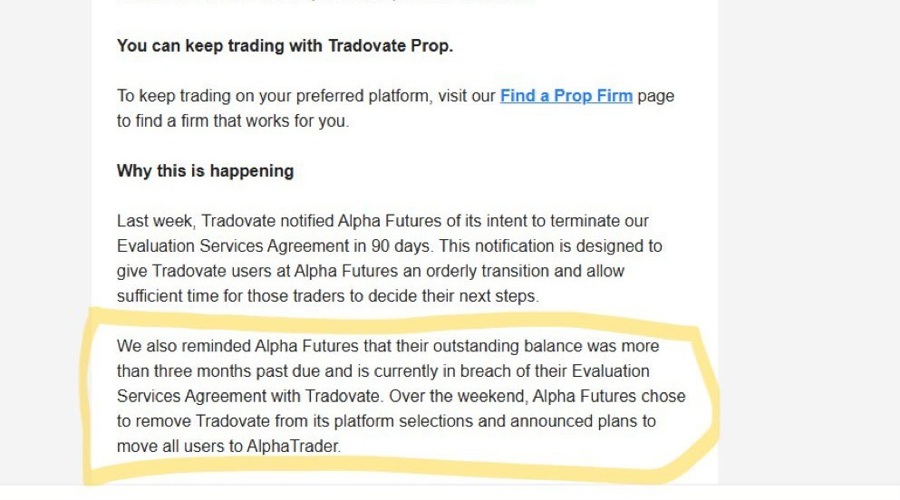
An email attributed to NinjaTrader circulating on X alleges a contract dispute involving an outstanding balance more than three months past due; a clear breach, it claims, of the Evaluation Services Agreement.
Alpha Futures, however, has responded with a voluminous public defence on X, including invoices and proof of payment.
What is Alpha Claiming?
According to the prop firm, a prior US$2.4 million overcharge dispute was settled in early 2026, leaving an allegedly "outstanding" US$225,700, which was believed to be credit remaining from that settlement.
The prop firm insisted that monthly payments remained current and that subsequent discussions had revolved solely around the co-existence of NinjaTrader, which owns Tradovate, and Alpha’s own new platform, AlphaTrader.
Addressing the Tradovate email that went out this evening:
— Alpha Futures (@Alpha_Futures_) July 14, 2026
We did not throw any punches at Tradovate on the way out, unfortunately they have not done the same, and have made an ambiguous statement regarding funds over due. We were prepared to just split ways but now are forced… pic.twitter.com/I4lZZgogXr
The terminal notice, it claims, arrived without warning on 9 July. According to Alpha, NinjaTrader’s sudden interest in this sum was merely a pretext; The company claims that the real issue is believed to be the launch of Alpha’s own platform, AlphaTrader.
Guaranteed Payouts Aren’t Always Guaranteed
The collateral damage of what is turning into a bitter spat was the prop firm’s Premium Plan, which was inextricably tied to NinjaTrader’s backend.
By pulling the plug, NinjaTrader effectively forced Alpha to liquidate the product entirely. Alpha claims to have paid out more than US$25 million via the plan in a mere two months, a rate of burn that suggests the plan was operating at a heavy loss.
For traders who successfully navigated their evaluations, the outcome is sobering: With the infrastructure gone, Alpha has closed all active accounts, offering only activation-fee refunds to those who completed their evaluations.
“All active Premium Accounts will be refunded and closed. This includes all pending and unpaid payouts on the Premium plan beyond the amount already paid,” the prop firm said in yesterday's announcement.
A Massive Backlash that Exposes A Systemic Vulnerability
The backlash has been massive.
Traders have taken to X to post screenshots showing thousands in voided profits, expressing fury and bafflement at the decision.
Well it’s official $10K payout VOIDED despite being approved!@Alpha_Futures_ have blood on their hand’s
— RC FUTURES (@RC_FUTURES) July 13, 2026
Can’t believe this is still happening in 2026 https://t.co/t1YhYAxeCx pic.twitter.com/FB0ZxG6kcr
At the same time, Alpha Futures was delisted from major industry directories.
"Traders should not lose payouts they have already earned without breaking any clearly stated rule," PropFirmMatch stated as the reason behind the delisting.
This has triggered an industry-wide trust crisis, as traders realise that "guaranteed" payouts may only be as secure as a firm’s vendor relations.
The payout fallout is far from an isolated event; rather, it serves as a glaring symptom of a broader, more systemic vulnerability within the market.
- AI Wave Reaches Prop Firms as FundedNext Launches MCP Server
- NinjaTrader Drops Alpha Futures as Rivals Smell Blood
- cTrader Restricts US Prop Firm Access Following "Internal Regulatory Assessment"
At the core of the issue is a reliance on customer failure, with industry data suggesting that roughly only 7% of traders who purchase an evaluation challenge ever reach a payout.
Many firms rely on a steady stream of evaluation fees to cover the payouts; consequently, when an unexpected operational shock emerges or a sudden drop in new sign-ups occurs, this liquidity model is pushed to its limits.
In 2024, Belgium’s FSMA was the first EU regulator to warn against prop trading firms, noting that they make money by selling challenges to retail traders, while the promised profit share from a funded trading account does not always materialise.
Moving Away from Third-Party Dependence
As Prop Trader Edge has reported, the Alpha Futures and NinjaTrader debacle pulls back the curtain on another persistent market issue: overreliance on third-party platforms.
The industry has, of course, been here before. The MetaQuotes exodus of 2024, which was the main catalyst for wiping out some 14% of the global market, was meant to be the definitive lesson in the perils of third-party overreliance.
However, it remains a strategic risk for a model already struggling to sustain itself.
On top of a revenue model that is largely fee-based, hundreds of copycat firms are flooding the market, leading to cutthroat competition driven by unsustainable perks, while sophisticated attempts to game the system proliferate.
There is clear evidence that the path forward involves building proprietary platforms and shifting toward more resilient, modular tech stacks. Firms are exploring multi-platform setups to avoid the single point of failure trap.
Yet, even alternative turnkey systems are proving volatile; cTrader, a popular choice for those fleeing MetaTrader, has already pulled out of the US market.
Speaking to Finance Magnates, Spotware, the developer behind cTrader, described the withdrawal as a strategic decision. “Following an internal regulatory assessment during the first quarter of 2026, we made the strategic decision to restrict the onboarding of US-based traders on the platform,” a company spokesperson said.
Meanwhile, major players like Topstep are pursuing vertical integration, acquiring their own routing technology to ensure complete control.
