





Thailand's quiet wealth: Resilience in a volatile world
PUBLISHED : 1 Dec 2025 at 14:36
NEWSPAPER SECTION: Business
WRITER: Thanachot Nontakatrakool
 Listen


Share
-
 Facebook
-
 Reddit
-
 Copy Link


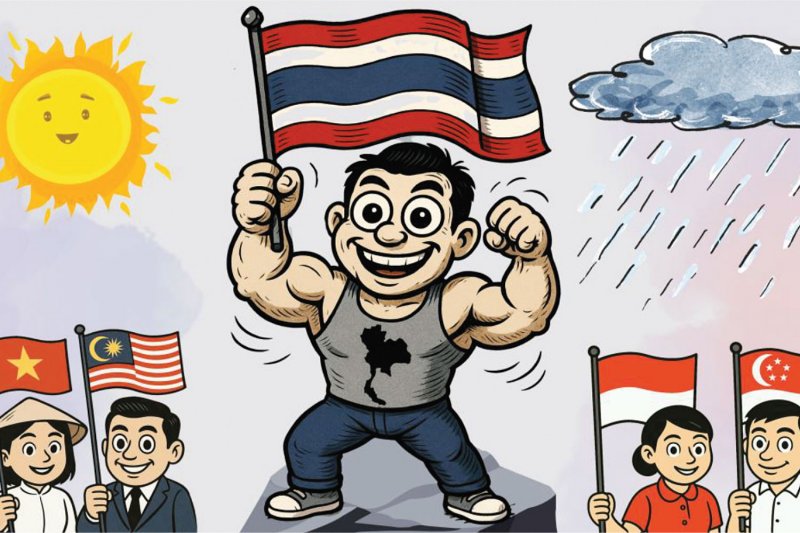
Imagine living in a neighbourhood where the weather changes without warning. One day the heat rises, the next day the wind shifts, and sometimes the rain falls even when the sky looks clear. That’s what the global economy feels like today rising debt, unpredictable capital movements and mounting currency pressures. But in the middle of this shifting climate, Thailand sits on one of the most stable patches of ground in the region.
Quietly, without much fanfare, the country has become one of Asean’s few net creditor nations. In short, it owns more of the world than it owes.
A Solid Position in a Moving Landscape
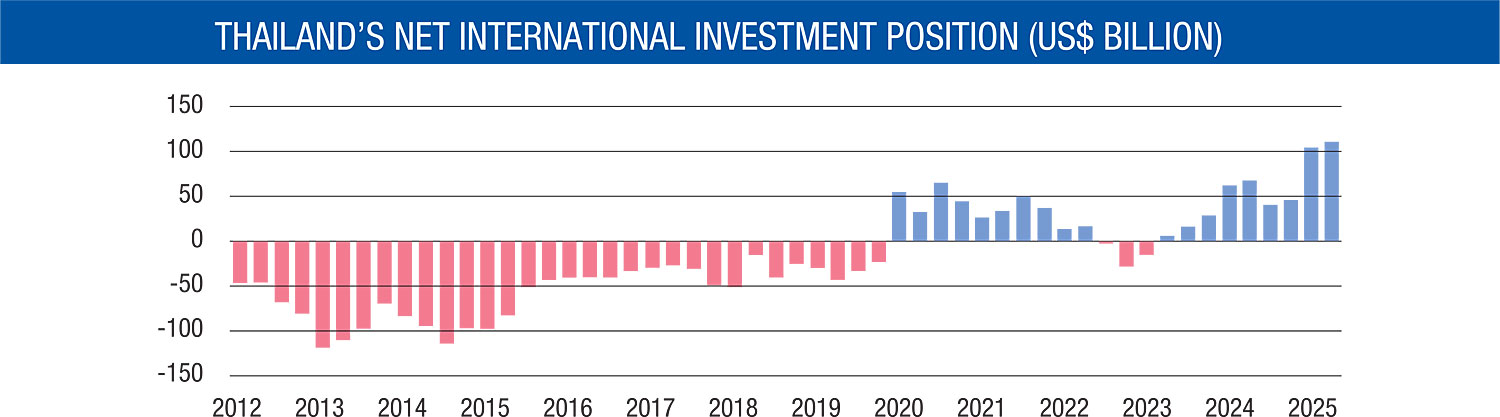
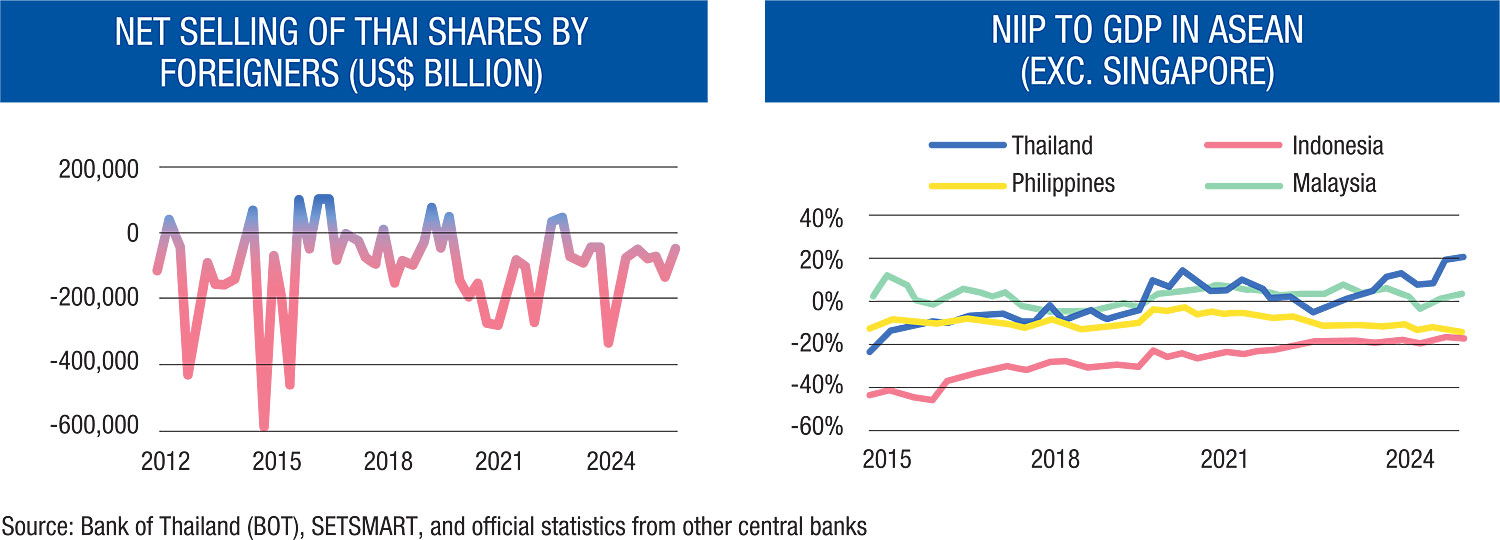
As of the second quarter of 2025, Thailand’s net international investment position (NIIP) stood at $109.5 billion, or 19.8% of gross domestic product (GDP), placing it well ahead of many regional peers whose NIIP remains negative. Indonesia, the Philippines and Malaysia continue to depend heavily on foreign capital.
Singapore, of course, plays in another league, holding net foreign assets of more than 150% of GDP. Yet Thailand’s progress remains significant. Over the past decade, the country has quietly transformed its external position from reliance on foreign capital to steady accumulation of foreign wealth.
What Makes Up Thailand’s External Wealth?
Thailand’s NIIP strength rests on three key components:
1. Foreign Reserves: The Safety Buffer
With $262 billion in reserves, Thailand covers short-term foreign debt several times over, giving it room to manage shocks without scrambling for emergency measures. This isn’t just a balance-sheet figure, it’s peace of mind, the ability to weather storms even when global markets are having nightmares. Thailand’s reserves far exceed its $84.6 billion in short-term external debt, reinforcing its capacity to absorb capital outflows and stabilise the baht during volatile periods.
2. Direct Investment Abroad: Earning Income
Thailand’s outward direct investment abroad is over $216 billion, nearly 30% of all foreign assets and about 40% of GDP. Thai firms now operate power plants across Asean, run consumer businesses throughout the region and own hospitality assets in Europe. These aren’t speculative bets. These are real businesses generating real profits and returning real income home. It’s Thailand playing offence, not just defence.
3. Portfolio Investment: Diversified and Global
Thailand’s pension funds, insurance firms and mutual funds have broadened their global exposure. This diversification lowers domestic concentration risk and provides a cushion when local financial returns weaken. It’s financial hedging executed quietly but effectively.
The Liability Side: Stable but Not Without Concerns
Thailand’s foreign liabilities remain stable, anchored in long-term investments in manufacturing and services. But foreign holdings of Thai equities and bonds have softened — a sign of cautious sentiment toward emerging market growth prospects.
International investors still come to Thailand, but they are more selective now. Stability earns respect, but it does not automatically inspire investor excitement if it’s not accompanied by compelling growth.
Asean in Comparison: Who’s Ahead?
External positions across Southeast Asia vary widely:
- Indonesia and the Philippines remain structurally reliant on foreign capital, making them vulnerable when global investors pull back or when major economies’ interest rates rise.
- Malaysia maintains a slightly positive NIIP — respectable, but not commanding.
- Singapore operates in another dimension entirely, with decades of sovereign wealth accumulation and an NIIP that makes other countries envious.
- Thailand’s shift from -20% to +20% in just 13 years stands out as one of the region’s most notable turnarounds — evidence of disciplined management.
Outlook Ahead
Accumulating external wealth is only the first chapter. The more important question is: how can Thailand turn this position into long-term advantage?
Thailand is now strong enough to move from defensive reserve protection to strategic, outward-looking investment. The fortress is built. The next step is deciding how to use it.
From Resilience to Strategic Vision
Thailand has achieved the difficult part: building external resilience through steady accumulation and disciplined investment. The numbers prove it.
The next phase requires ambition and clarity. Will Thailand simply protect what it has, or will it leverage its position as a net creditor to shape its future more deliberately?
Nations that successfully converted external wealth into lasting advantage did so through long-term planning and strong institutions. Singapore used external assets to build state capacity. Norway prepared for a world beyond natural resources.
Thailand Now Stands at a Similar Crossroads The question is no longer whether Thailand is financially resilient, it clearly is. The real question is whether the country can transform that resilience into a durable competitive edge.
Because the true power of being a net creditor is not merely surviving global volatility. It is using external wealth to build a stronger, safer and more future-ready Thailand.
- KEYWORDS
- Thailand
- Investment
