





Sunrise Brokers

Summary
This Final Notice concerns breaches of PRIN 2 and PRIN 3 relating to financial crime risk in the trading company division. We impose a financial penalty.
Disclosure text
Final Notice: Sunrise Brokers LLP Firm Reference Number: 208265 Address: 5 Churchill Place, London, E14, 12 November 2021 Page 5 1. Pursuant to section 206 of the Financial Services and Markets Act 2000, action is taken on the grounds set out in this Final Notice 1.1 ... the Financial Conduct Authority ('the Authority') hereby imposes on Sunrise Brokers ('Sunrise' or 'the Firm') a financial penalty of £642,400, of which £407,273 is disgorgement of unlawful profits. 1.2 Sunrise agrees to settle this matter and is eligible for a 30% (Stage 1) discount under the Authority's enforcement settlement procedure. Without this discount, the Authority would have imposed a financial penalty of £743,200 on Sunrise. 2. Summary of reasons 2.1 Combating financial crime is an issue of international importance and forms part of the Authority's operational objective to protect and enhance the integrity of the UK financial system. Authorised firms face the risk of being abused by those seeking to commit financial crime, such as fraudulent trading and money laundering. Firms must therefore establish effective systems and controls to identify and mitigate the risk that their business is used for such purposes, and act with due skill, care and diligence to comply with the systems and controls they have in place so that financial crime risk is properly assessed, monitored and managed. 2.2 Between 17 February 2015 and 4 November 2015 ('the Relevant Period'), Sunrise a) did not have adequate systems and controls to identify and mitigate the risk of fraudulent trading and money laundering in connection with business conducted with four authorised entities known as the Solo Group, thereby breaching Principle 3; and b) did not exercise due skill, care and diligence in implementing its anti-money laundering policies and procedures and failed properly to assess, monitor and mitigate the risk of its being used to facilitate fraudulent trading and money laundering in connection with Solo Trading, Elysium Payments and the German Trade (together 'the Solo Group Business'), thereby breaching Principle 2. 2.3 The Solo Clients were offshore companies, including Malaysian-registered entities and a number of previously unknown US 401(k) individual pension plans at Sunrise. They were introduced by the Solo Group, which claimed to provide clearing and settlement services to clients within a closed network as custodian through a bespoke over-the-counter trading and settlement platform called Brokermesh. The Solo Clients were controlled by a small number of individuals, some of whom had worked for the Solo Group, and were apparently unable to obtain sufficient funds to settle the trades. 2.4 During the Relevant Period, on behalf of Solo Clients, Sunrise executed alleged over-the-counter stock dividend trades worth approximately £25.4 billion in Danish equities and £11.2 billion in Belgian equities, and received £466,652 in commissions during the Relevant Period. 2.5 Solo Trading was characterised by a circular pattern of allegedly very high-value OTC equity trades, back-to-back stock lending arrangements and forward transactions involving EU equities on or around the last cum-dividend date. After the alleged cum-dividend trades on the specified dates, the same trades were subsequently reversed over days or weeks to offset the apparent shareholding positions ('Close-out Trades'). 2.6 The alleged OTC trades executed by Sunrise through Brokermesh could not have obtained liquidity from public exchanges, yet the alleged trades were almost always completed within minutes and represented up to 20% of the issued shares of Danish Stock Exchange-listed companies and up to 9.6% of Belgian stocks. The volumes were also equivalent to an average of 36 times and 22 times, respectively, all Danish and Belgian stock trading volumes on the relevant last cum-dividend trading day on European exchanges. 2.7 The Authority's investigation and conclusions regarding the alleged trades are based on a range of information, including analysis of transaction reporting data and materials received from Sunrise, the Solo Trading Group and five other brokerage firms involved in Solo Trading. The cum-dividend trading volumes of the six brokerage firms combined allegedly represented 15%-61% of the free float of Danish stocks traded and 7%-30% of the free float of Belgian stocks traded. These volumes are considered implausible, particularly given the obligation to disclose holders of more than 5% of Danish and Belgian listed stocks. 2.8 As broker for the equity trades, Sunrise executed the alleged cum-dividend trades and the alleged Close-out Trades. However, the FCA considers it unlikely that Sunrise would have executed the alleged cum-dividend trades and the alleged Close-out Trades in the same stock for the same client at the same size, and therefore it is likely that Sunrise saw only one side of the alleged trades. In addition, the FCA considers it likely that the alleged stock loans and forward transactions connected with Solo Trading were used to obscure the overall scheme and/or give the overall scheme an appearance of legitimacy. Although there is evidence that Sunrise knew about the alleged stock lending and forward transactions, these transactions were not carried out by Sunrise. 2.9 The purpose of the alleged trades was to enable the Solo Group to arrange for the creation of Dividend Credit Advice Notes ('DCAS'), intended to show that Solo Clients held the relevant shares on the dividend record date. In some cases, the DCAS were then used to reclaim withholding tax ('WHT') from the Danish and Belgian tax authorities under double taxation treaties. In 2014 and 2015, the value of Danish and Belgian WHT recoveries attributable to the Solo Group was approximately £899.27 million and £188.00 million respectively. In 2014 and 2015, the Danish and Belgian tax authorities paid approximately £845.9 million and £42.33 million in refunds respectively. 2.10 The Authority refers to Solo Trading as 'alleged' because it has found no evidence that Solo Clients owned the shares, or that the Solo Group held the shares in custody or settled the trades. Combined with the very large volumes of shares allegedly traded, this strongly suggests complex financial crime. 2.11 Sunrise staff did not establish adequate systems and controls to identify and mitigate the risk of being used to facilitate fraudulent trading and money laundering in connection with business conducted with the Solo Group. In addition, Sunrise staff did not exercise due skill, care and diligence in applying anti-money laundering policies and procedures and failed properly to assess, monitor and mitigate the financial crime risks associated with Solo Clients and the alleged trades. 2.12 Sunrise did not have appropriate policies and procedures to assess properly the risks of the Solo Group Business and failed to recognise the risks involved in Solo Trading. This led to inadequate customer due diligence, a failure adequately to monitor transactions and identify unusual transactions. This increased the risk that the firm could be used to facilitate financial crime connected with Solo Trading. 2.13 The manner in which Solo Trading was conducted, and its scale and volume, strongly suggested financial crime. The Authority's findings are also made in the context of this finding and taking into account that these matters have given rise to additional investigations by tax authorities and/or law enforcement agencies in other jurisdictions, as publicly reported. Although the alleged underlying misconduct of the Solo Group has not so far led to any finding of fraud, tax authorities and/or law enforcement agencies are investigating in other jurisdictions. 2.14 In addition to Solo Trading, during the Authority's other significant transactions and visits, Sunrise ignored or failed to notice a series of red flags relating to a German equity trade executed on 3 September 2015 on behalf of a broker client. The onboarding and trading circumstances relating to that broker client should have prompted Sunrise to consider the serious financial crime risk presented by the trade, particularly given that the trade was executed at almost twice the stock's current market value. 2.15 On 4 November 2015, the firm also accepted a payment from a UAE entity associated with the Solo Group called Elysium. The payment was made by Elysium to repay some outstanding debts owed to the firm by Solo Clients. After receiving an offer of payment through the Solo Group, Sunrise accepted a payment of US$108,000 from Elysium, having never previously heard of the entity and without carrying out any anti-money laundering checks or reaching any agreement. Sunrise accepted this payment from Elysium on the same day as the Authority conducted a surprise visit to alert Sunrise to possible problems within the Solo Group. 2.16 In neither case did Sunrise identify or escalate any potential financial crime issue or suspicion. 2.17 The Authority also visited Sunrise in November 2014, shortly before Solo Trading began, as part of its work to raise standards in the brokerage industry. The Authority assessed the firm's anti-money laundering, KYC and market abuse detection arrangements and raised with Sunrise that its financial crime and anti-money laundering controls were weaker than required. After the visit, the Authority notified Sunrise of a number of areas of concern and in response Sunrise provided a work plan that included a review of its AML and KYC framework to be completed by July 2015. Sunrise did not conduct an in-depth review of its financial crime risk controls until April 2016. The commissioning of this review was commercially driven: Sunrise was in acquisition discussions with a potential buyer. Breaches and failings 2.18 Principle 3 requires firms to take reasonable care to organise and control their affairs responsibly and effectively, with adequate risk management systems. The Authority considers that Sunrise breached this requirement during the Relevant Period because its policies and procedures were inadequate to identify, assess and mitigate financial crime risk. Sunrise failed to: a) provide adequate guidance on obtaining and assessing sufficient information when attracting clients about the purpose and intended nature of the business relationship, the expected level and nature of the activities to be carried out, and when it was appropriate to make enquiries about the source of funds; b) provide adequate guidance for conducting risk assessments of clients, including the relevant risk factors to be considered in order to determine the correct level of CDD to apply, including whether EDD was required; c) establish appropriate processes or procedures detailing how EDD should be conducted, including enhanced monitoring requirements for high-risk clients; d) provide adequate guidance on its risk-based approach to customer due diligence for new clients introduced by authorised firms, where reliance may be placed on KYC documentation provided by the authorised firm for the new client, and detail the appropriate circumstances; e) establish any formal process or procedure detailing how and/or specifying the circumstances and frequency in which Sunrise should monitor and record client transactional activity throughout the relationship with the firm in order to assess financial crime and anti-money laundering risk; f) establish escalation procedures for identifying, managing and recording financial crime and anti-money laundering risks. 2.19 The Authority considers that, during the Relevant Period, Sunrise failed to act with due skill, care and diligence as required by Principle 2 in implementing its own (limited) anti-money laundering policies and procedures and in assessing, monitoring and managing the financial crime risks faced by its Solo Group Business. In particular, Sunrise failed to: a) act promptly to implement the work plan to address deficiencies identified in its compliance function following the Authority's inspection in November 2014; b) conduct adequate risk assessments or adequate due diligence when taking on the Solo Group Business, which meant that they were not properly identified as high-risk clients; c) conduct adequate customer due diligence at onboarding for each Solo Client, including the purpose and intended nature of the business relationship, the expected level and nature of the activities to be carried out, and the source of funds and/or trading history, so as to provide a meaningful basis for transaction monitoring; d) conduct a risk assessment for each Solo Client as required by the compliance documents, but failed to determine that Solo Clients presented a higher financial crime risk and that EDD should therefore have been completed; e) conduct any EDD for Solo Clients that presented a higher money laundering risk, but then failed to determine which EDD measures might be appropriate for ongoing monitoring of Solo Clients; f) assess each Solo Client against the classification criteria set out in COB 3.5.3 and/or failed to record the results of such assessments, including sufficient information to support the classification, in breach of COB 3.8.2R(2)(a); g) follow its own compliance policy when Sunrise began trading on behalf of Solo Clients before they had been onboarded; h) conduct any ongoing transaction monitoring of Solo Trading throughout the Relevant Period; i) recognise the many red flags of the alleged Solo Trading, including that Sunrise did not consider whether it was reasonable and/or realistic for the size and volume of trades carried out for Solo Clients within a closed network of entities to be provided with adequate liquidity. Similarly, it failed to consider or recognise that the profiles of Solo Clients meant that they were highly unlikely to be able to reach the size and volume of trades allegedly being conducted, and/or failed at least to obtain adequate evidence of the clients' source of funds to satisfy the contrary; j) give adequate consideration to the financial crime and money laundering risks relating to the German Trade in circumstances that strongly suggested potential financial crime; k) give adequate consideration to the relevant financial crime and money laundering risks relating to the Elysium Payment, where the firm accepted a payment of approximately US$108,000 from Elysium without any due diligence or agreement, shortly after a surprise visit by the Authority to alert Sunrise to concerns about the Solo Group; l) make and retain adequate, or in some cases any, written records as evidence of the work it may have carried out specifically relating to the consideration and discussion of financial crime and anti-money laundering matters by Sunrise management. 2.20 Sunrise's failings warrant a significant financial penalty. The Authority considers these failings particularly serious for the following reasons: 1. Sunrise attracted 142 Solo Clients in a short period, some of them from jurisdictions that do not have the same anti-money laundering requirements as the UK; 2. Sunrise's anti-money laundering policies and procedures were disproportionate to the risks of the business it conducted; 3. Sunrise failed properly to review and analyse the KYC materials provided by Solo Clients, or to ask appropriate follow-up questions about red flags in the KYC materials; 4. even when some red flags arose, Sunrise failed to conduct any ongoing monitoring, allegedly allowing Solo Clients to trade shares totalling approximately £36.6 billion; 5. after the Authority's visit in November 2014, Sunrise was notified that its financial crime and anti-money laundering controls were weaker than required. However, Sunrise failed to improve and apply appropriate anti-money laundering systems and controls and admitted Solo Clients in the same month that it represented to the compliance function; 6. Sunrise executed the German equity trade at almost twice the current share price while ignoring many red flags that strongly suggested financial crime risk; 7. on 4 November 2015, following the Authority's surprise visit and notification of concerns about the Solo Group, Sunrise accepted the Elysium payment; 8. finally, none of these deficiencies were identified or escalated by Sunrise during the Relevant Period. 2.21 Taken together, these deficiencies exposed Sunrise to unacceptable financial crime risk. Accordingly, in order to promote the Authority's operational objective of protecting and enhancing the integrity of the UK financial system, the Authority hereby imposes on Sunrise a financial penalty of £642,400. 3. Definitions 3.1 This Notice uses the following definitions: '401(k) pension plan' means a US employer-sponsored retirement plan. Eligible employees may make pre-tax contributions, but withdrawals from the account are taxable. Roth 401(k) plans are essentially similar; however, contributions are after-tax, but withdrawals are tax-free. For the 2014 tax year, the annual employee contribution limit was US$17,500, with an additional contribution of US$5,500 for employees aged 50 and over. For the 2015 tax year, the employee contribution limit was US$18,000 and the catch-up limit was US$6,000. For a more detailed analysis, see Annex C; '2007 Regulations' or 'Regulations' means the Money Laundering Regulations 2007 or specific regulations therein; 'the Act' means the Financial Services and Markets Act 2000; 'AML' means anti-money laundering; 'AML Certificate' means an anti-money laundering introduction form provided by one authorised firm to another. The form confirms that a regulated firm has fulfilled its customer due diligence obligations in relation to a client and authorises another regulated firm to rely on it under regulation 17; 'the Authority' or 'FCA' means the Financial Conduct Authority, known before 1 April 2013 as the Financial Services Authority; 'Broker Firm' means other brokerage firms that agreed with the Solo Group to carry out Solo Trading; 'Brokermesh' means the bespoke electronic platform established by the Solo Group for Solo Clients to submit buy and sell cash equity orders and for Sunrise Brokers to seek liquidity and execute the alleged trades; 'CDD' means customer due diligence measures, i.e. the measures a firm must take under regulation 5 to identify each client and verify their identity, and to obtain information about the purpose and intended nature of the business relationship; 'Clearing Broker' means an intermediary responsible for coordinating trade orders between both sides of a transaction. Typically, a clearing broker verifies the availability of appropriate funds, ensures delivery of securities in exchange for cash as agreed at the time of trade execution, and records the transfer; 'COB' means the Authority's Conduct of Business sourcebook; 'Compliance Documents' means the Risk-Based Client Acceptance Procedures for the Business Division v1 dated 28 April 2015; the Risk-Based Client Acceptance Procedures for the Business Division, v2, 27 April 2015; AML Policy v3, 22 January 2014; 'Compliance Manual v2.doc' or the Compliance Manual dated December 2013; the Introduction Certificate Form dated 28 April 2015; 'cum-dividend' means that the buyer of a security is entitled to the next planned dividend distribution, which has been declared but not yet paid. Shares trade cum-dividend before the ex-dividend date, and after the ex-dividend date the shares trade without the right to the dividend; 'cum-dividend trade' means the alleged cum-dividend share trades carried out by individual clients to demonstrate an apparent shareholding position entitling them to dividends in order to submit dividend reclaims; 'Custodian' means a financial institution that safekeeps client securities. They also provide other services such as account administration, transaction settlement, collection of dividends and interest, tax support and foreign exchange; 'DCAS' means Dividend Credit Advice Notes. These are completed and submitted to overseas tax authorities in order to reclaim tax paid on dividends received; 'DEPP' means the Authority's Decision Procedures and Penalties Manual; 'dividend arbitrage' means the practice of placing shares in alternative tax jurisdictions around the dividend date for the purpose of minimising withholding tax (WHT) or generating WHT recoveries. Dividend arbitrage may involve a number of different activities, including equity trading and lending and derivative transactions, including futures and total return swaps, designed to hedge movements in the price of securities during the dividend date; 'double taxation treaty' means a treaty between the country paying the income and the country of residence of the recipient. A double taxation treaty may allow a reduction or refund of the applicable withholding tax; 'EDD' means enhanced due diligence, i.e. the measures a firm must take in certain circumstances, as set out in regulation 14; 'Elysium' means Elysium Global (Dubai) Limited; 'Elysium Payment' means the payment of approximately US$108,000 received by Sunrise on 4 November 2015 from Elysium in respect of debts owed to Sunrise by Solo Clients; 'Executing Broker' means a broker that buys and sells shares solely on behalf of clients. A broker does not advise clients when to buy or sell shares; 'European Exchange' means registered execution venues, including regulated markets, multilateral trading facilities, organised trading facilities and alternative trading systems included in the Bloomberg European Composite Index; 'Financial Crime Guide' means the Authority's comprehensive guidance on financial crime, published under the title 'Financial Crime: A Guide for Firms'. In this Notice, the applicable versions for the Relevant Period were published in January 2015 (including updates effective 1 June 2014) and April 2015. The Financial Crime Guide contains 'general guidance' as defined in section 139B of the Financial Crime Guide. The guidance is not binding, and the Authority will not presume that a firm's breach of the guidance means that the firm has breached the Authority's rules. However, as stated in FCG 1.1.8, the Authority expects firms to understand the financial crime guidance applicable to them and to consider the applicable guidance when establishing, implementing and maintaining their anti-financial crime systems and controls; 'German Trade' means the EUR 5 million 'buy' order executed by Sunrise on behalf of a broker client ('Client X') on 3 September 2015 for 146,397 German shares at a specified intraday price of EUR 34.15; 'Handbook' means the collection of effective regulatory rules, manuals and guidance issued by the Authority during the relevant period; 'JMLSG' means the Joint Money Laundering Steering Group, made up of the main trade associations in the UK financial services industry; 'JMLSG Guidance' means the 'Guidance for the UK Financial Sector on Preventing Money Laundering/Combating Terrorist Financing' issued by JMLSG, which has been approved by the Treasury under the legal requirements of the 2007 Regulations. The JMLSG Guidance sets out good practice for preventing money laundering and combating terrorist financing in the UK financial services sector. In this Notice, reference is made to the applicable provisions in the version dated 19 November 2014; the Authority will consider whether a firm has complied with the relevant provisions of the JMLSG Guidance when deciding whether there has been a breach of the anti-money laundering systems and controls rules and when considering whether to take action involving a financial penalty or censure. Breach of these rules (SYSC 3.2.6E and DEPP 6.2.3G); 'KYC' means know your client, referring to CDD and EDD obligations; 'KYC Pack' means the package of client identity information received, usually including company registration documents, certified copies of identity documents, utility bills and CVs; 'MLRO' means money laundering reporting officer; 'OTC trade' means an off-exchange transaction not carried out on a regulated exchange; 'Principles' means the Authority's Principles for Businesses set out in the Handbook; 'Relevant Period' means the period from 17 February 2015 to 4 November 2015; 'SCP' means Solo Capital Partners LLP; 'Solo Clients' means the entities introduced by the Solo Group to Sunrise and other brokers, and on whose behalf Sunrise executed the alleged equity trades during the Relevant Period for some clients; 'Solo Group' or 'Solo' means the four authorised firms owned by Sanjay Shah, a British national residing in Dubai, details of which are set out in paragraph 4.19; 'Solo Group Business' means Solo Trading, the German Trade and the Elysium Payment; 'Solo Trading' means the alleged cum-dividend trades and alleged Close-out Trades executed for Solo Clients during the Relevant Period; 'Sunrise' means Sunrise Brokers LLP; 'Tribunal' means the Upper Tribunal (Tax and Chancery Chamber); 'UBO' means ultimate beneficial owner, with 'beneficial owner' as defined in regulation 6; 'Close-out Trade' means the alleged trades carried out over days or weeks to reverse the alleged cum-dividend trades in order to offset the apparent shareholding position; 'WHT' or 'withholding tax' means tax deducted from income and passed on to the government by the paying entity. Many securities pay income regularly in the form of dividends or interest, and local tax rules often impose withholding tax on such income; 'WHT refund' means that, in some circumstances, withholding tax imposed on payments to foreign entities may be refunded if a double taxation treaty exists between the country paying the income and the country of the recipient. A double taxation treaty may allow a reduction or refund of the applicable withholding tax. 4. Facts and matters background Sunrise 4.1 Sunrise is an inter-dealer broker which, during the Relevant Period, primarily facilitated transactions between counterparties in listed and OTC derivative products, typically for established listed companies, international investment banks, hedge funds and asset managers. 4.2 Sunrise provided brokerage services in equities, exotic equities, credit, hybrids and commodity derivatives across a range of asset classes; execution services for bonds and cash equities. Sunrise was not authorised to take positions, trade on its own account or hold any client money. Sunrise was authorised to deal and advise for eligible counterparties and professional clients in a range of investment types, but was not permitted to deal or advise for retail clients. During the Relevant Period, Sunrise's London office employed approximately 100 staff. Sunrise's failings 4.3 Sunrise staff did not establish adequate systems and controls to identify and mitigate the risk of fraudulent trading and money laundering in connection with business conducted with four authorised entities known as the Solo Group. In addition, Sunrise staff did not exercise due skill, care and diligence in applying anti-money laundering policies and procedures and failed properly to assess, monitor and mitigate the financial crime risks associated with the Solo Group Business. Legal and regulatory provisions 4.4 The legal and regulatory provisions relevant to this Warning Notice are set out in Annex B. 4.5 Principle 3 requires firms to take reasonable care to organise and control their affairs responsibly and effectively, with adequate risk management systems. The 2007 Regulations and the rules in the Authority's Handbook further require firms to establish and implement policies and procedures to prevent and detect money laundering and to address the risk of being used to facilitate financial crime. These include systems and controls to identify, assess and monitor money laundering risk, and to conduct customer due diligence and ongoing monitoring of business relationships and transactions. 4.6 Principle 2 requires firms to conduct business with due skill, care and diligence. A firm that merely has the systems and controls required by Principle 3 is not sufficient to avoid the ever-present risk of financial crime. Firms must also operate those systems and controls with appropriate skill, care and diligence as required by Principle 2 in order to protect themselves and properly assess, monitor and manage financial crime risk. 4.7 Money laundering is not a victimless crime. It is used to fund terrorists, drug traffickers and human traffickers, as well as many other criminal activities. If firms fail to apply money laundering systems and controls thoughtfully and diligently, they risk facilitating these crimes. 4.8 Firms must therefore consider money laundering risk in their day-to-day operations, including risks associated with new product development, taking on new clients and changes in business profiles. In doing so, firms should consider their client, product and activity profiles and the complexity and volume of transactions. 4.9 The Joint Money Laundering Steering Group ('JMLSG') has issued detailed guidance intended to promote good practice and provide practical assistance in interpreting the 2007 Regulations and evolving practice in the financial services industry. In considering whether there has been a breach of the anti-money laundering systems and controls rules, the Authority will consider whether the firm has complied with the relevant provisions of the JMLSG Guidance. 4.10 The Authority has also issued substantive guidance on the importance of anti-money laundering controls in the form of the Financial Crime Guide, which cites examples of good and poor practice, publications of anti-money laundering thematic reviews and regulatory notices. Authority visit to Sunrise in November 2014 4.11 The Authority visited Sunrise on 25 November 2014 and the Authority 'identified areas requiring the firm's attention' in relation to Sunrise's AML/KYC arrangements and market abuse controls. These areas were set out in a follow-up letter to Sunrise dated 23 December 2014. This was before Sunrise had engaged with Solo to accept Solo Clients or changed its business to incorporate Brokermesh activity. 4.12 The key issues identified by the Authority regarding the effectiveness of Sunrise's anti-money laundering/know-your-client arrangements included: 1) 'an apparent lack of compliance resources appeared to affect the firm's ability to implement AML controls properly'; 2) 'it appeared necessary to formalise the entire AML and KYC process. For example, the risk scoring methodology did not appear to be clearly documented, and it was unclear whether clients were assigned specific risk ratings'; 3) 'transaction monitoring checks did not appear to be conducted for high-risk clients'; 4) the Authority 'could not determine the firm's formal position on key AML risks'; 5) 'formal AML/KYC information was not reported to the board periodically'; and 6) Sunrise's compliance officer 'was the source of a significant amount of information about processes and decisions, which ... represented an increased key person risk'. 4.13 The key issues regarding the effectiveness of Sunrise's market abuse controls included: 1) 'there did not appear to be a timetable for market abuse training'; 2) FCA staff 'were told that the firm used an automated monitoring system to screen all trades. However, it was not clear to us whether the firm fully understood the parameters of [this] system. For example, it was unclear whether the system covered all brokerage products, identified unusual trading patterns ... the extent to which the system was implemented and the targets set according to key risks remained unclear'. 4.14 In its follow-up letter, the Authority informed Sunrise that it expected Sunrise to produce a work plan listing the issues raised, including (among other things): 1) formalise and document its AML/KYC approach, clearly setting out its risk-based client acceptance/review and transaction approach, and submit formal AML reports to senior management; 2) assess and address gaps in the market abuse training programme; 3) review 'the relevant risks inherent in the business model' and ensure 'appropriate transaction monitoring systems and controls are in place to comply with the STR regime'. 4.15 On 30 March 2015, after beginning onboarding of Solo Clients and in response to the Authority's visit, Sunrise sent the FCA a work schedule stating (among other things): 1) additional resources had been added to the compliance department, and more would be added as needed; 2) a work plan around the effectiveness of: a. AML/KYC arrangements would be completed by the end of July 2015; and b. market abuse controls would be completed by the end of May 2015. 4.16 Sunrise considered that its compliance function needed some administrative support but was otherwise adequate. Sunrise stated that the key areas for improvement it had identified from the Authority's visit were the need to hire 17 additional resources for the compliance function, primarily to provide additional administrative support and improve the compliance department's document retention methods. Sunrise did not consider that the Authority's visit indicated deficiencies in its client onboarding approach, including risk assessment and KYC. Sunrise did not consider from its conversations with the Authority that there was any particular urgency in resolving the issues raised, but did regard the recruitment of staff to assist with compliance administration as something it should act on immediately. 4.17 Sunrise stated that 'towards the end of 2015' (i.e. after the Authority's surprise visit), the firm realised that not everything in the Authority's letter had been resolved and that the work plan had not been implemented in a timely manner. This coincided with Sunrise's discussions about a possible acquisition of the firm by another company. 4.18 In April 2016, Sunrise instructed an external compliance consultant to conduct an independent review of its compliance documents. The prospect of acquisition was the main driver for seeking external compliance support, rather than the Authority's visit and follow-up letter (although the letter was used to inform how Sunrise approached the independent review). Solo Group 4.19 The four authorised firms referred to by the Authority as the Solo Group are owned by Sanjay Shah, a British national currently residing in Dubai: Solo Capital Partners LLP ('SCP') was first authorised in March 2012 and is a broker. West Point Derivatives Ltd was first authorised in July 2005 and is a broker in the derivatives market. Old Park Lane Capital Ltd was first authorised in April 2008 and is an agency stockbroker and corporate broker. Telesto Markets LLP was first authorised on 27 August 2014 and is a wholesale custody bank and fund manager. 4.20 During the Relevant Period, SCP and other members of the Solo Group held, at various stages, regulatory permissions to provide custody and clearing services. Since December 2015, Solo Group has not been permitted to carry out any activities regulated by the Authority, and Solo Capital Partners formally entered special administration insolvency proceedings in September 2016. The other three entities are in administration. Background to dividend arbitrage and the alleged Solo Trading Dividend arbitrage trading 4.21 The purpose of dividend arbitrage is to place shares in certain tax jurisdictions around the dividend date in order to minimise withholding tax (WHT) or generate WHT recoveries. WHT is a tax withheld at source from dividends paid to shareholders. 4.22 If the beneficial owner is located outside the country of issue of the shares and the country of issue has a relevant treaty with the country of residence of the beneficiary ('double taxation avoidance treaty'), the beneficial owner may be entitled to a tax refund. Dividend arbitrage therefore aims to transfer temporarily the beneficial ownership of shares overseas, timed to coincide with the dividend payment date, so as to satisfy the criteria for a WHT refund. 4.23 Because the strategy is only a temporary transfer strategy, 'stock lending' transactions are usually used to execute it. Although such transactions are treated economically as loans, the right to a refund depends on the actual transfer of ownership. The legal structure of the 'loan' is therefore a sale of shares, subject to the borrower's obligation to provide equivalent shares to the lender on a specified future date. 4.24 Dividend arbitrage may expose either party to significant market risk because the value of the shares may rise or fall over the life of the loan. To mitigate this, the strategy will usually include a series of derivative transactions to hedge the market risk. 4.25 A key role of the share custodian in a dividend arbitrage strategy is to issue certificates to the beneficial owner proving ownership on the date the dividend right arises. The certificate will also state the dividend amount and the amount withheld at source. This is sometimes called a 'dividend credit advice note' or 'credit note'. The purpose of the certificate is for the beneficial owner to present it to the relevant tax authority to reclaim WHT (assuming a relevant double taxation treaty exists). The certificate usually proves that (i) the shareholder was the beneficial owner of the shares at the relevant time, (ii) the shareholder received the dividend, (iii) the amount of the dividend, and (iv) the tax withheld from the dividend. 4.26 Given the nature of dividend arbitrage trading, the cost of executing the strategy is usually commercially justified only if a large number of shares are traded. Alleged Solo Trading 4.27 The Authority's investigation and understanding of the alleged trades in this case are based partly on analysis of transaction reporting data and materials received from Sunrise, the Solo Trading Group and five other brokerage firms involved in Solo Trading. Solo Trading was characterised by a circular pattern of very large alleged OTC equity trades, back-to-back stock lending arrangements and forward transactions. 4.28 Solo Trading can be divided into two stages: (i) alleged trading in shares when they were cum-dividend, in order to demonstrate an apparent shareholding position entitling the client to dividends for the purpose of submitting WHT returns ('cum-dividend trades'); and (ii) alleged trading in shares when they were ex-dividend, connected with the scheduled dividend distribution activity after the cum-dividend trades, in order to reverse the apparent shareholding positions held by Solo Group clients during the cum-dividend trades ('close-out trades'). 4.29 The total trading volume of the alleged cum-dividend trades of the six brokerage firms represented between 15% and 61% of the free float of Danish stocks traded and between 7% and 30% of the free float of Belgian stocks traded. 4.30 As broker for Solo Trading, Sunrise executed the alleged cum-dividend trades and the alleged close-out trades. However, the FCA considers it unlikely that Sunrise would have executed the alleged cum-dividend trades and the alleged close-out trades in the same stock for the same client at the same size, and therefore it is likely that Sunrise saw only one side of Solo Trading. In addition, the FCA considers it likely that the alleged stock loans and forward transactions connected with Solo Trading were used to obscure the overall scheme and/or give the overall scheme an appearance of legitimacy. Although there is evidence that Sunrise knew about the alleged stock lending and forward transactions, these transactions were not carried out by Sunrise. 4.31 The purpose of the alleged Solo Trading was to enable the Solo Group to arrange for the creation of DCAS, intended to show that Solo Clients held the relevant shares on the dividend record date. In some cases, the DCAS were then used to reclaim WHT from the Danish and Belgian tax authorities under double taxation treaties. In 2014 and 2015, the value of Danish and Belgian WHT recoveries attributable to the Solo Group was approximately £899.27 million and £188.00 million respectively. In 2014 and 2015, the Danish and Belgian tax authorities paid approximately £845.9 million and £42.33 million in WHT refunds respectively. 4.32 The Authority refers to the trading as 'alleged' because it has found no evidence that Solo Clients owned the shares, or that the Solo Group held the shares in custody and settled the trades. Sunrise launches Solo Group Business in October 2014 4.33 In October 2014, the Solo Group approached Sunrise with a business proposal to join a bespoke trading platform called Brokermesh, under which Sunrise would execute equity trades for 'hundreds of fund clients' and the Solo Group would provide custody and clearing services for all trades on the platform. The proposal was particularly attractive to Sunrise because it had been unable to find an entity to provide clearing services and because it could bring some work to an area of the firm that generated no revenue. According to one member of Sunrise staff, Solo's proposal 'gave us a solution that could bring in some revenue, rather than ... us sitting there getting nothing, I mean, actually absolutely nothing, doing nothing every day'. 4.34 In short, the relevant business area was heavily, if not entirely, dependent on the Solo Group Business. There was therefore significant commercial pressure to bring revenue to the relevant department. In these circumstances, Sunrise should have recognised the conflict of interest arising from the lack of revenue in the specific area and the need to ensure that the potential business introduced was suitable for the firm and consistent with its regulatory obligations and relevant policies. 4.35 Sunrise met twice with representatives of the Solo Group to discuss the proposal (30 October 2014 and 16 December 2014). Before this introduction, Sunrise had no established business relationship with the Solo Group, although they had conducted several Solo Capital transactions. Sunrise did not record any records or notes of these initial meetings. In the initial email discussions, Solo told Sunrise that 'Solo's relationship with brokers is primarily as one of software provider, and we happen to have clients in common. Solo has contracts with brokers that administer this service'. 4.36 Sunrise estimated that the projected revenue from the Solo Group proposal was between £500,000 and £1 million per year, based on charging Solo Clients a fee of one quarter of a basis point of the notional value of each trade. To achieve the projected revenue, Sunrise calculated that it would need to execute trades worth £20 billion to £40 billion per year for Solo Clients. 4.37 Although Sunrise carried out 'commercial discussions and due diligence' before commencing the Solo Group Business, it did not conduct a formal or documented risk assessment when it decided to enter into the service agreement with the Solo Group. Sunrise explained that it 'felt fairly comfortable' because the Solo Group entities were regulated by the Authority and because other authorised firms that 'it considered reputable and assumed would also conduct due diligence' had registered with the Brokermesh platform. However, Sunrise did not have any specific conversations with the other brokerage firms involved to discuss compliance issues or concerns, or to confirm its assumption that they were comfortable with the arrangements in which they were involved. 4.38 On 6 February 2015, in a telephone call with Solo, Sunrise asked about the structure of the Solo Group in relation to Brokermesh. Sunrise could not see the reason why four Solo Group entities were involved. Solo did not identify a specific reason, saying only that it was Sanjay Shah's preference and that this would spread the revenue stream among the four brokerage firms. In a further call between the Solo Group and Sunrise on 9 February 2015, Sunrise questioned the rationale behind the structure and the nature of the arrangement, stating that '... there is a need to understand ... that what is being done is legal ... we will not participate in anything that has not gone through the proper due diligence process'. There is no record of whether and how this query was answered. 4.39 On 17 February 2015, Sunrise signed an agreement with the Solo Group under which the Solo Group would provide clearing and settlement services to Solo Clients ('the Service Agreement'), and Sunrise signed the Brokermesh licence terms. Sunrise understood that it would not be liable for any settlement failure if trades did not settle and that all trades would be subject to approval by the Solo Group. 4.40 The Solo Group informed Sunrise before the Service Agreement was signed that the trading would involve pan-European equities. Within Sunrise it was assumed that the trading would involve dividend arbitrage. Sunrise did not, however, seek any further information from the Solo Group about the intended nature and purpose of Solo Trading. Onboarding of Solo Clients Introduction to onboarding requirements 4.41 The 2007 Regulations require authorised firms to use their onboarding processes to obtain and review information about potential clients in order to meet their KYC obligations. 4.42 Under regulation 7 of the 2007 Regulations, firms must conduct customer due diligence when establishing a business relationship or carrying out an occasional transaction. 4.43 As part of the CDD process, firms must first identify the client and verify their identity. Second, firms must identify the beneficial owner (if relevant) and verify their identity. Finally, firms must obtain information about the purpose and intended nature of the business relationship. 4.44 In order to confirm the appropriate level of CDD a firm must apply, the firm must conduct a risk assessment, taking into account the type of client, the business relationship, the products and/or the transaction. Firms should also document their risk assessment and keep it up to date. 4.45 If a firm determines through a risk assessment that a client presents a higher risk of money laundering or terrorist financing, it must apply EDD. This may mean that the firm should obtain additional information about the client, the beneficial owner (if any) and the purpose and intended nature of the business relationship. Other information collected during EDD should be used to inform the firm's risk assessment process so that money laundering/terrorist financing risk is effectively managed. Firms need to obtain information about their clients' circumstances and business that is necessary to provide a basis for monitoring client activity and transactions, so that the firm can effectively detect when its products are being used for money laundering and/or terrorist financing. Onboarding chronology 4.46 On 17 February 2015, the onboarding process for Solo Clients began when the Solo Group started providing KYC documents to Sunrise in respect of Solo Clients. This was the first time Sunrise had received information about the names of Solo Clients and the jurisdictions in which they were located. Between 10 March 2015 and 6 May 2015, 142 Solo Clients were onboarded as follows: Date Number of clients onboarded 10 March 2015 12 11 March 2015 69 20 March 2015 28 23 March 2015 6 1 April 2015 24 6 May 2015 3 4.47 This included a total of 81 clients registered within two business days on 10 and 11 March 2015, and the remaining clients recorded on four non-consecutive business days on 20 and 23 March 2015, 1 April 2015 and 6 May 2015. 4.48 Solo Trading began on 25 February 2015, nearly two weeks before any Solo Client was recorded as an onboarded client, and eight days after onboarding began on 24 February 2015. Sunrise therefore began trading with some Solo Clients before fulfilling its obligations under the 2007 Regulations (in particular regulation 7), which was a direct breach of the Compliance Documents. At this stage, Sunrise should have been prepared and willing to decline clients if they presented unacceptable risk. 4.49 Sunrise onboarded 142 clients introduced by the Solo Group in less than two months. By comparison, there were 48 clients unrelated to the Solo Group onboarded by Sunrise during the entire Relevant Period. The onboarding rate was also different: the 48 unrelated clients were onboarded over more than 41 days, while the Solo Clients were onboarded over 6 days. Among the clients unrelated to the Solo Group onboarded separately during the Relevant Period, no more than two clients were onboarded on the same day. 4.50 Sunrise acknowledged that onboarding all Solo Clients 'effectively in one go' was not a 'usual' thing and was 'a bit rushed'. However, Sunrise was under pressure to complete onboarding of Solo Clients on its own, and Sunrise was keen to ensure that it did not lose the business on offer. Sunrise stated that it was concerned that if it did not onboard in accordance with Solo's timetable, it 'might be dropped from the project'. 4.51 Not only was the volume of client onboarding unusual for Sunrise, but the Solo Clients also deviated from the type of clients Sunrise normally had. Sunrise's top 20 clients in the Relevant Period were large investment banks or large institutional funds. In contrast, Solo Clients included approximately 118 401(k) pension plans, and almost all of the pension plans and entities were established in 2014, which was itself a red flag. Moreover, during the Relevant Period, while Sunrise did not execute any Danish equity trades for its top 20 clients, Sunrise allegedly executed very large cum-dividend trades in Danish equities worth approximately £25.4 billion for Solo Clients, knowing that the vast majority of these clients had recently established individual pension plans. 4.52 The Solo Clients were all located in the United States or Malaysia. Although Sunrise had no Malaysian clients before onboarding the Solo Clients, 24 of the Solo Clients were incorporated in Labuan (Malaysia). Although the Solo Clients were not located in the UK, Sunrise did not give any additional consideration to onboarding. 4.53 The KYC materials provided to Sunrise showed that almost all of the Solo Client entities had only one UBO, and many of those UBOs each owned multiple entities. Some UBOs were connected to the Solo Group. Sunrise did not realise or consider this unusual at the time. CDD 4.54 CDD is an essential part of the onboarding process and must be conducted when onboarding new clients. Firms must obtain and hold sufficient client information to inform the risk assessment process and effectively manage money laundering risk. 4.55 As part of the CDD process, under regulation 5 of the 2007 Regulations, firms must first identify the client and verify their identity. Second, firms must identify the beneficial owner (if relevant) and verify their identity. Finally, firms must obtain information about the purpose and intended nature of the business relationship. A. Client identification and verification 4.56 Regulation 20 of the 2007 Regulations requires firms to establish and maintain appropriate and risk-sensitive policies and procedures relating to customer due diligence. SYSC 6.3.1R requires policies to be comprehensive and proportionate to the nature, scale and complexity of their activities. 4.57 Sunrise stated that the firm used a 'risk-based approach' to accepting potential clients during the Relevant Period, in accordance with its client acceptance policy and the JMLSG Guidance. Paragraph 8.1 of Sunrise's AML Policy stated that the firm needed to be 'reasonably satisfied that their clients are who they say they are' in order to make it 'harder for the financial services industry to be used for the purposes of money laundering or handling the proceeds of crime'. It guided Sunrise staff on the firm's client acceptance policy. The policy itself did not provide further guidance on what 'reasonable' meant. 4.58 Sunrise's Compliance Manual stated that the firm had established client acceptance procedures to meet its client identification requirements, which were the same regardless of business area. The AML Policy stated that the identification process existed in part to 'help the firm identify unusual situations that may arise during the ongoing relationship' and to indicate whether a client might be involved in money laundering, fraud or handling criminal or terrorist property. 4.59 Sunrise's client acceptance procedures purportedly contained the following information that Sunrise staff 'in all cases seek to obtain'. The steps (performed in numerical order) included: (i) determine who the client is and who needs to be identified; (ii) determine the overall risk of the proposed client relationship; (iii) record the products and services requested by the client; (iv) determine whether information provided by another firm can be relied on instead of collecting information directly from the client, and if so, collect the appropriate certificate; (v) if another firm cannot be relied on, determine the information required and collect the documents; (vi) complete the client acceptance summary form. 4.60 Sunrise acknowledged, however, that there may be discrepancies and/or contradictions in the Compliance Documents. This was because part of their source was a member of the firm's staff who had drafted parts of them for another firm. As a result, the Compliance Documents were not adequately updated, adapted or amended to reflect Sunrise's business. Key parts of the Compliance Documents (such as checklists) appeared to be missing. Reliance on Solo's due diligence 4.61 In addition, the client acceptance procedures stated that 'in many cases, you will find that, due to the low-risk nature of the relationship, Sunrise Brokers is able to rely on another party for some or all of the client identity'. The client take-on procedures did not provide further detail on when Sunrise would rely on another party for some or all client identification, what factors should be considered, or what specific steps should be taken. 4.62 The JMLSG Guidance states that firms should adopt a risk-based approach when deciding whether to accept third-party confirmation that appropriate CDD measures have been carried out on a client, and that this 'cannot be based on a single factor'. It also states that, if relying on a third party, the firm still needs to know the identity of the beneficial owner whose identity is being verified; the level of CDD conducted; and confirm that the third party understands its obligation to provide copies of verification data, documents or other information on request. 4.63 Sunrise's client acceptance procedures also stated that for 'all clients, it is essential' that Sunrise 'understands the type of entity and all parties associated with it'. They also stated that introduction certificates should be obtained by Sunrise when an equivalently regulated entity confirms that it has identified and verified a specific client. Sunrise did not provide evidence that these were obtained for Solo Clients. 4.64 The client acceptance procedures also provided that a general assurance could be provided by 'an undertaking from one regulated firm to another that, for all current and future introduced clients, the original client has obtained or will obtain and retain sufficient evidence of identity for the owners'. However, these permitted introductions only in certain limited (but unspecified) circumstances where there was a one-off transaction for a low-risk client between a clearing and an executing broker, or where the client was an unregulated fund that might need to identify the relevant investors (provided the client was essentially low or medium risk). 4.65 Sunrise's approach to onboarding Solo Clients relied unreasonably on the fact that the Solo Clients were introduced by another regulated firm. The fact that the introducer was regulated appeared to be the only factor Sunrise considered when deciding the level of due diligence to apply. In essence, because the Solo Clients were introduced by a regulated entity, Sunrise did not treat them as previously unknown clients and did not conduct due diligence on Solo Clients as it did for other clients. Sunrise acknowledged that this practice 'in hindsight ... we would not do now'. B. Beneficial owners and beneficial owner verification 4.66 As set out in paragraph 4.55 above, under regulation 5 of the 2007 Regulations, firms must identify the beneficial owner of a client (if relevant) and verify their identity. Sunrise's client acceptance procedures stated: 'Identifying and verifying whether such owners are the source individual, or the stage at which ownership belongs to a lower-risk entity or a chain of entities, is essential to protect the firm from money laundering risk'. 4.67 Sunrise stated that 'every client file was reviewed to find the beneficial owner, and who was authorised to trade on that person's behalf'. These documents were reviewed on the understanding that they had been certified and notarised and provided to us, and did include passports and utility bills. ... So at least to ensure that the documents we held for the underlying client were correct, or that I thought they were correct at the time. 4.68 During the due diligence process, the KYC documents received in relation to Solo Trading showed that the UBOs of Solo Clients were former Solo Group employees, but this did not 'really raise any question about whether this person was suitable'. Sunrise because the person was considered a 'market professional'. 4.69 Nor was Sunrise concerned when the KYC documents showed that the sole beneficiary of a Solo Client was an 18-year-old university student who shared the same home address as the fund manager. This 18-year-old university student was also the ultimate beneficial owner of four other 401(k) pension plans onboarded by Sunrise. Sunrise stated that it would not raise any concern about an 18-year-old conducting large-scale trades because 'the fund had a manager' trading on behalf of the student, although the student said it was 'unusual' to share the fund manager's home address. C. Purpose and intended nature of the business relationship 4.70 As part of CDD, regulation 5(c) of the 2007 Regulations requires firms to obtain information about the purpose and intended nature of the business relationship. Firms should use this information to assess whether the client's financial behaviour over time is consistent with their expectations, whether the client may be involved in criminal activity, and to provide a meaningful basis for ongoing monitoring of the relationship. 4.71 Regulation 20 of the 2007 Regulations requires firms to establish and maintain appropriate and risk-sensitive policies and procedures relating to customer due diligence, and SYSC 6.3.1R requires these policies to be comprehensive and proportionate to the nature, scale and complexity of their activities. 4.72 Sunrise's Compliance Manual stated that it was important for the firm to 'understand the client's business in order to assess the consistency of its transactions and the activities carried out, and thereby determine what might be suspicious or unusual'. 4.73 Sunrise's client acceptance procedures stated that the firm must obtain and record 'the reasons why the client is seeking Sunrise Brokers' products and/or services. This will ensure that Sunrise Brokers fully understands the entity, structure and ownership'. However, the Compliance Documents did not establish any framework or guidance for staff on understanding the purpose and intended nature of the business relationship with each client. 4.74 On 17 February 2015, Sunrise first received KYC documents for Solo Clients from the Solo Group. Although the Compliance Documents did provide some examples of information, there was no comprehensive written checklist to assist in reviewing KYC documents during onboarding. Sunrise should have obtained this when conducting due diligence. 4.75 The CDD work Sunrise carried out on Solo Clients was limited to checking the documents received and conducting identity checks on Solo Clients and the ultimate beneficial owners of each onboarded entity. Sunrise stated that its review of the KYC documents did not raise any concerns. The Authority considers that Sunrise's review of the KYC documents was very rushed given the commercial pressure that Solo brought to the firm. Sunrise therefore lacked adequate review. 4.76 Sunrise failed to identify a number of red flags that should have been obvious on careful examination of the KYC documents. Sunrise did not question why Solo Clients were using 401(k) pension plans for highly speculative short-term dividend arbitrage, since such plans are mainly used to hold personal savings. Nor did Sunrise question how likely it was that individual Solo Clients would conduct transactions requiring Solo Clients to hold such high levels of funds, particularly when Sunrise did not know the limits on 401(k) pension plan contributions or otherwise check the source of those funds. Had it done so, Sunrise would have found that the value of Solo Trading was many times greater than the maximum funding that a US 401(k) pension plan established in the previous year could provide. 4.77 Without this basic level of review, Sunrise failed to complete the customer due diligence steps required by regulation 5 of the 2007 Regulations. Risk assessment 4.78 As part of the onboarding and due diligence process, firms are required to conduct and document a risk assessment for each client. Such assessment should be based on information.
Attachments
1 in total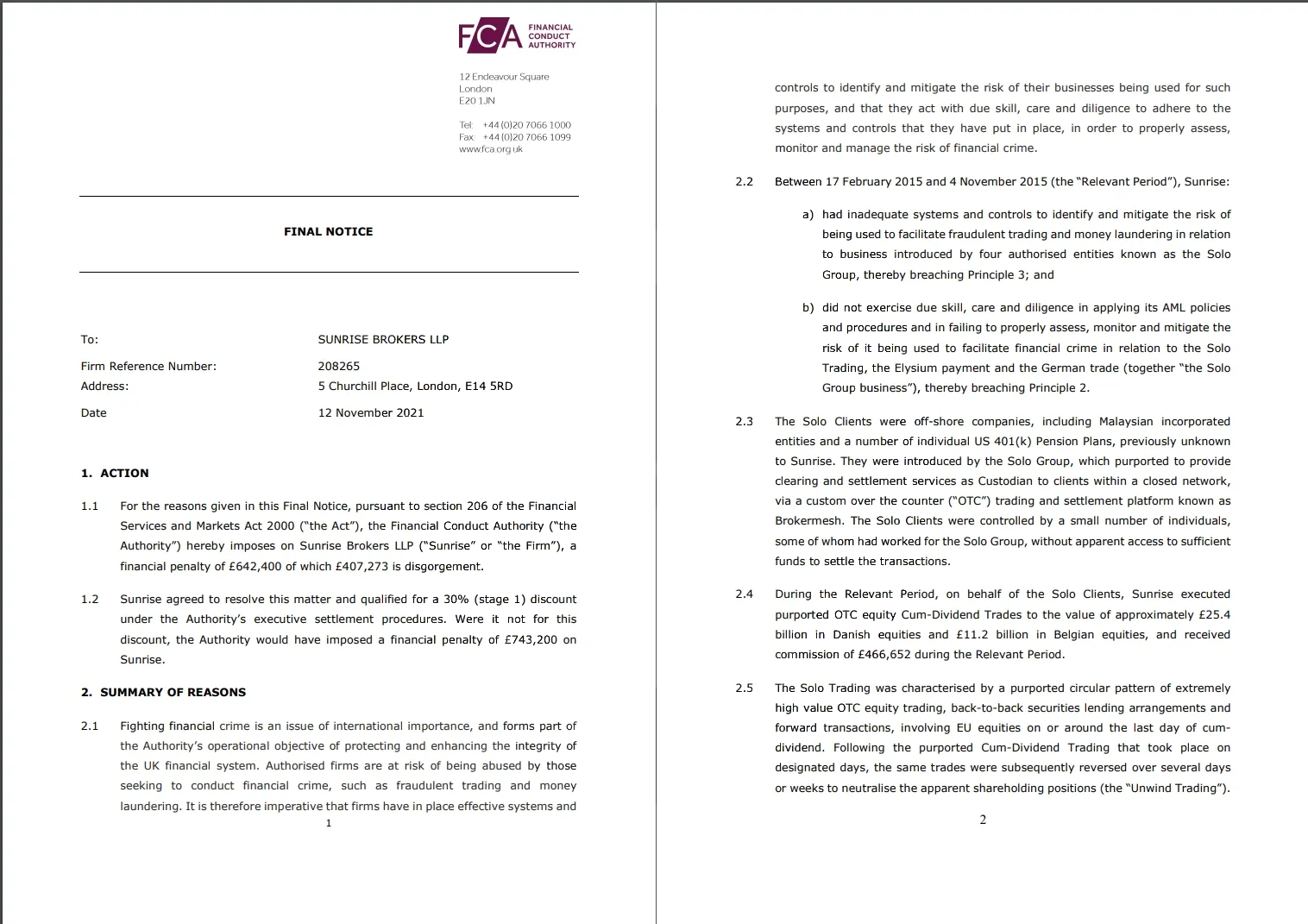
The image could not be loaded. Please try again.
