





Financial Conduct Authority fines Credit Suisse and Yorkshire Building Society over financial promotion failures

Summary
The Financial Conduct Authority (FCA) has today fined Credit Suisse International (CSI) and Yorkshire Building Society (YBS) for failing to ensure that financial promotions for CSI's Cliquet product 1 were clear, fair and not misleading. CSI has been fined £2,398,100 and YBS £1,429,000.
Disclosure text
Cliquet products were designed by CSI to provide capital protection and a guaranteed minimum return, with significantly higher potential returns if the FTSE 100 performed consistently well. The probability of achieving only the minimum return was 40-50%, and the probability of achieving the maximum return was close to 0%. Nevertheless, CSI's and YBS's financial promotions still marketed the product's potential maximum return as a key promotional feature. CSI described the target market for the Cliquet product as conservative and risk-averse 'stepping stone customers'. The product was typically sold through many distributors to unsophisticated investors with limited investment experience and knowledge. 83,777 customers invested a total of £797,380,716 in the product; YBS was a distributor, accounting for about 75% of total investment. In the product brochure for the Cliquet product approved by CSI and provided to customers, and in YBS's own financial promotions for the product, maximum return figures were over-prominent, and some of them also did not clearly explain how returns would be calculated. Tracey McDermott, FCA Director of Enforcement and Financial Crime, said: 'It is essential that firms consider customers' needs from product design through marketing and sales. The information provided to customers is an important part of this. Financial promotions are often the main source of information for consumers, and in this case CSI and YBS let their customers down badly. These promotions seriously breached the clear, fair and not misleading requirement. CSI and YBS knew that the chance of achieving the maximum return was close to zero, yet they still emphasised it as a key promotional feature of the product. This is unacceptable.' In September 2010, after concerns were raised by third parties (including Which?), YBS changed its promotions so that it no longer over-emphasised the potential maximum return. However, YBS continued to cite the potential maximum return and created an unfair impression of the likelihood of achieving it. CSI also reviewed its promotions in response to third-party concerns but decided not to make substantial changes to its product brochure. In addition, the FCA found that CSI had failed to establish procedures to regularly conduct comprehensive reviews of its long-term promotions. If CSI's processes had included such reviews, this might have led to the problems in the product brochure being remedied earlier. Both firms agreed to settle at an early stage of the FCA investigation, and therefore received a 30% settlement discount. Today's fines are the first time the FCA has taken action against both a product manufacturer and its distributor at the same time.
Attachments
2 in total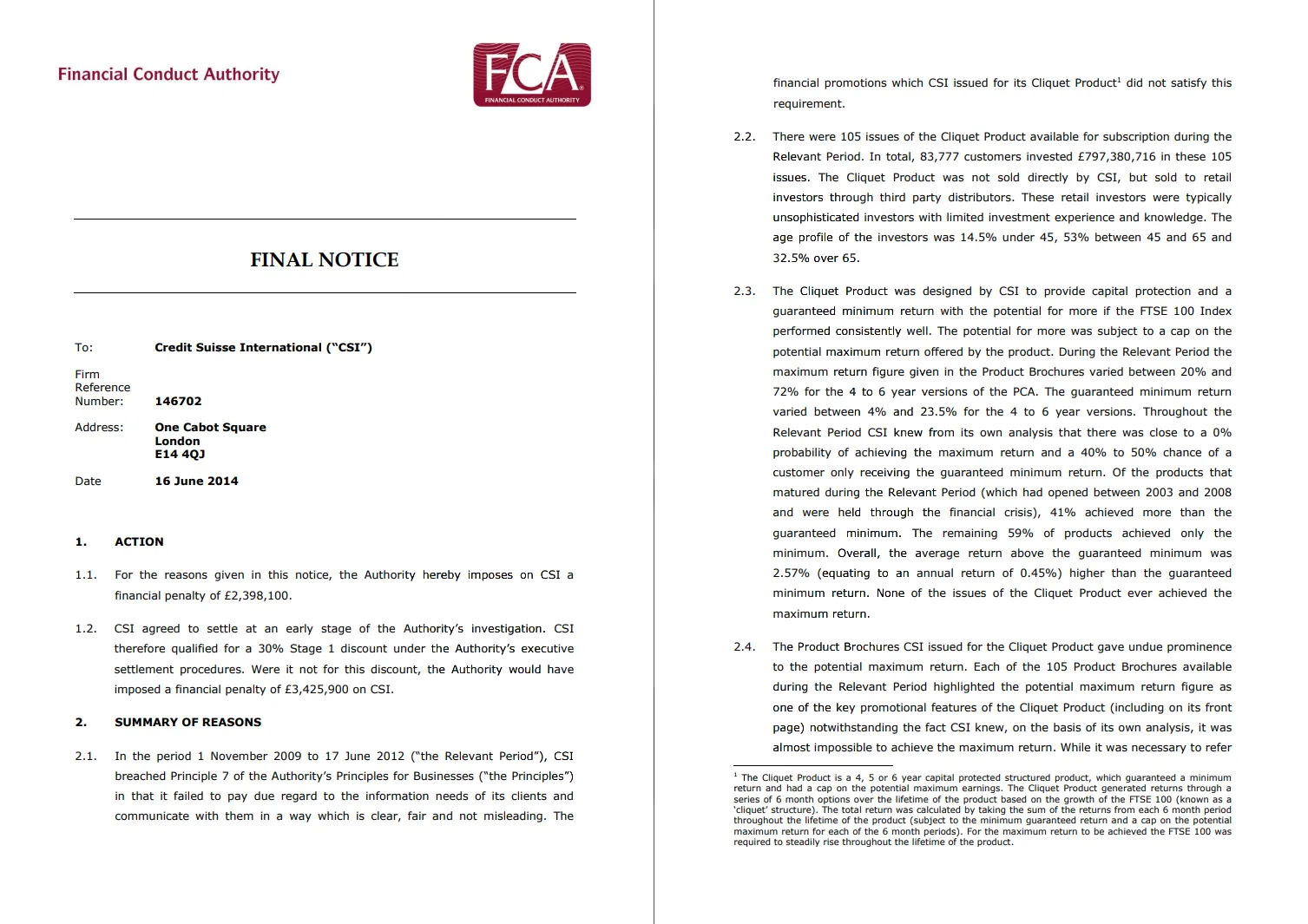
- FXR638024829117225816_783944.png_wiki-template-global PNG_WIKI-TEMPLATE-GLOBAL Open file
The image could not be loaded. Please try again.
