





Prediction-market combos and CFDs are structurally different, but their retail dynamics are beginning to look similar: professional firms price complex risk, while individual traders are drawn to products offering large potential payouts.
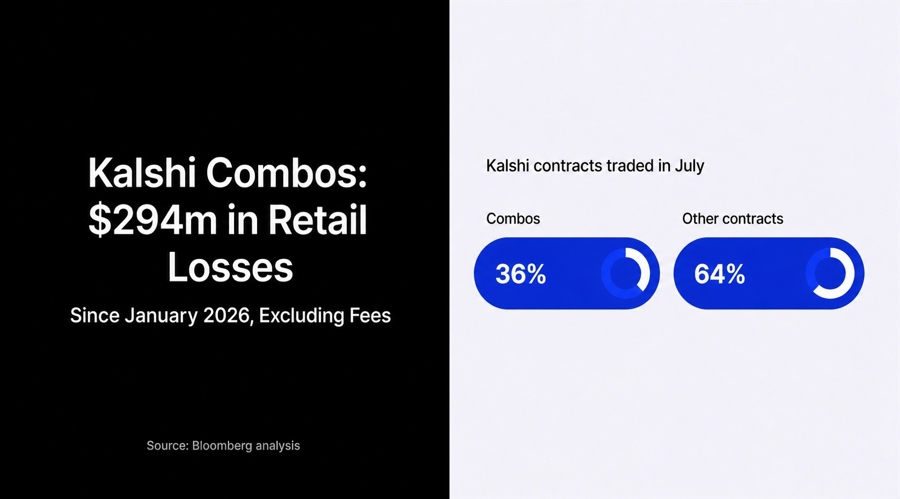
On Kalshi, multi-leg combo markets accounted for 36% of contracts traded so far in July. Retail customers have generated net losses of $294 million on the products since the start of 2026, excluding fees, according to a Bloomberg analysis.
Why Combo Contracts Are Harder to Price
Combos bundle several outcomes into one contract, with every leg required to succeed for the contract to settle “Yes”. Probabilities compound, while correlations between outcomes can make fair value difficult to calculate.
Bloomberg found that Kalshi combos carried an average implied probability of 9%, compared with 43% for other contracts.
The source of complexity differs from CFDs. A CFD provider acts as the customer’s counterparty and may internalise or hedge the resulting exposure, while leverage magnifies market movements. A prediction exchange matches participants, with market makers pricing combinations and correlations.
In both cases, professional firms typically have greater modelling, technology and risk-management capacity than retail customers.
Neither structure means that every retail participant will lose. However, high-payout formats can attract less experienced users while rewarding accurate pricing and disciplined risk management.
Of more than 30,000 same-game combinations traded during the World Cup final, fewer than 3% settled “Yes”. Bloomberg separately calculated net customer losses of more than $5 million on those contracts.
- Rothera Joins Peers in Expanding Trade Surveillance for Prediction Markets
- Fanatics Brings Prediction Markets Infrastructure In-House With BGC Deal
- Prediction Market Tournaments Reach Prop Trading as Tradeify Attracts 30,000 Participants on Plaee’s Platform
Regulators Have Seen the Pattern in CFDs
Previous Finance Magnates reporting found a similar concentration of returns across prediction markets.
An analysis of about 1.7 million Polymarket addresses showed that roughly 70% had recorded realised losses, while fewer than 0.04% captured more than 70% of realised profits. Separate data showed a positive median return only among traders with more than $500,000 in activity.
Regulators documented persistently high retail loss rates in CFDs before restricting their distribution.
ESMA found that 74% to 89% of retail CFD accounts typically lost money. Its measures included leverage limits, margin close-out rules, negative-balance protection and standardised loss warnings.
The FCA, which found that about 80% of CFD customers lost money, made comparable UK restrictions permanent in 2019. Neither regulator was commenting on prediction markets.
The comparison remains limited by an important structural difference. Prediction exchanges generally do not warehouse customer risk like sportsbooks.
Kalshi earns fees while market makers compete to quote against customer requests, so trading losses may accrue to counterparties rather than the venue itself.
As combos account for a larger share of activity, their retail dynamics are beginning to resemble those seen in complex financial products: difficult pricing, unequal analytical resources and returns concentrated among a small group of participants.
