





France’s financial markets regulator, the Autorité des Marchés Financiers (AMF), issued a public warning about a growing number of fraudulent schemes operating through cloned news websites. Scammers are increasingly copying the visual identities and branding of major media outlets, such as Le Monde, Le Figaro, France Info and TF1, to publish fabricated articles promoting illegitimate get-rich-quick opportunities, including an unauthorised entity operating under the name BitKeltTrade.
These articles use deepfake content and fabricated quotes attributed to high-profile political figures, business executives and sports celebrities, claiming that they discovered automated, AI-driven trading platforms during live interviews.
Beyond France: A Worldwide Scam Network
This model is far from unique to France and represents a growing global problem. In Australia, law enforcement agencies and investigative journalists recently exposed an extensive fraud network that used similar fake-news campaigns to target more than 4,000 Australian victims.
According to findings reported by the Organised Crime and Corruption Reporting Project (OCCRP) and local media, the network directed potential victims through fabricated media websites and promises of AI-assisted trading, resulting in hundreds of millions of dollars in losses. The operation reportedly involved a network of international call centres spanning several countries, including Israel, Bulgaria, Ukraine, Cyprus, South Africa and the Philippines.
- Silver Scam Costs Investors $6.9 Million in Fake Precious Metals Scheme
- Mining Capital Coin CEO Indicted for $62 Million Crypto Scam
- CFTC Charges Two Florida Residents and Their Firm with $19 Million Futures and Forex Fraud
AMF: Scale of Impersonation Scams
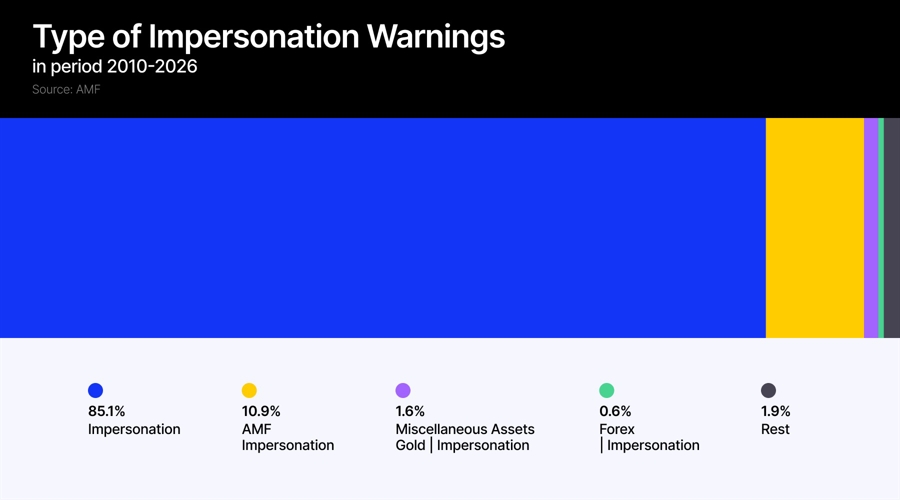
An analysis of AMF enforcement data between 2010 and 2026 shows that identity usurpation and brand impersonation have become dominant tactics among fraudsters targeting retail investors. Of all impersonation-related warnings issued by the French regulator during this period, corporate and brand impersonation accounted for 85.1%, or 1,317 warnings.
Fraudsters also targeted the regulator itself, with direct AMF impersonation representing 10.9%, or 168 warnings. Smaller categories included impersonation involving tangible assets or gold platforms at 1.6% (24 warnings), foreign exchange brokers at 0.6% (9 warnings), and miscellaneous categories accounting for the remaining 1.9% (30 warnings).
The figures demonstrate the value fraudsters place on established brands: borrowing the credibility of recognised media organisations, financial companies or public authorities can make fraudulent offers appear significantly more trustworthy.
Monthly data for 2025 and 2026 further illustrate the persistence and volatility of these campaigns. You can find full analysis with data at Finance Magnates Intelligence portal.
